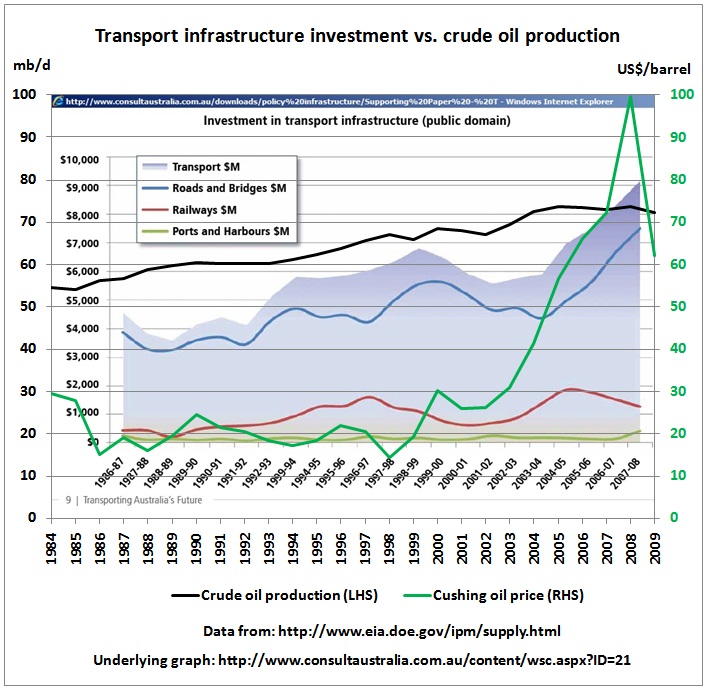
As oil production is peaking since 2005, expenditure for oil dependent roads has been increasing while at the same time investments in energy efficient rail are decreasing. Just the opposite of what should be done.
Click to enlarge.
I have overlaid crude oil production and oil prices on a graph from a recently published report by Consult Australia. Just as oil production started to peak, investments in road infrastructure showed a substantial increase and rail investments dropped off. Here is an excerpt of the report:
Transporting Australia’s Future
Diminishing Oil Reserves: Australian transport uses 46 billion litres of petroleum per year. World consumption may have exceeded production, suggesting we have passed the peak of the Oil Age, having consumed half of the world’s reserves in one human lifetime. New energy sources and a changed transport paradigm are needed to maintain the accessibility that communities and our economy require.
8.1 The Climate Change and Peak Oil Challenge
These increases in emissions are occurring against background improvements in fuel intensity of around
1.5 per cent per annum. Such improvements are however being countered by increasing travel – driven in
part by population growth but also increasing prosperity. The cost of travel by car and aircraft has grown
more slowly than increases in incomes, contributing to growth in demand for passenger travel per capita.
Decoupling transport from greenhouse gas emissions will be one of the most significant challenges of
decarbonisation of the economy (see Chapter 2). While technologies such as electric vehicles appear
promising in the near to medium term, there remain challenges of driving down costs to achieve mass
market penetration. Furthermore, in the case of electrification of the transport fleet, significant challenges
are presented to the stationary power sector to move to low or zero emission energy sources and adapt the
grid to the very different load profiles presented by electric vehicles.
http://www.consultaustralia.com.au/content/wsc.aspx?ID=21
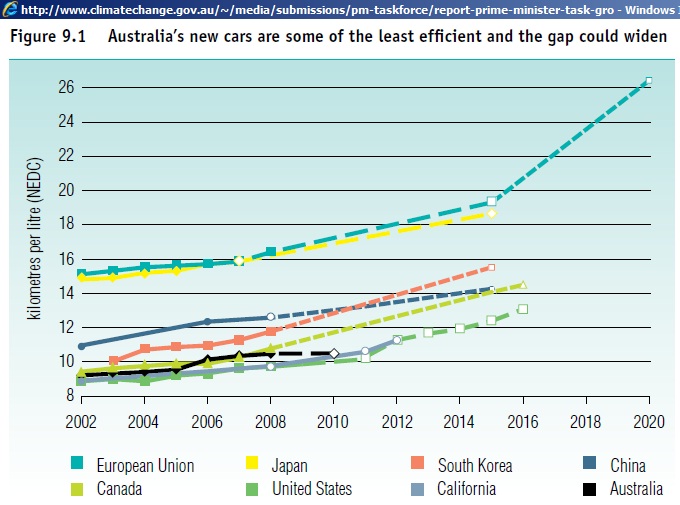
Unfortunately, the fuel efficiency of cars in Australia is NOT improving
The Prime Minister’s Task Group on energy efficiency has recently released a report with this graph showing that kms travelled per litre of fuel has not been increasing over the last years, despite higher oil prices:
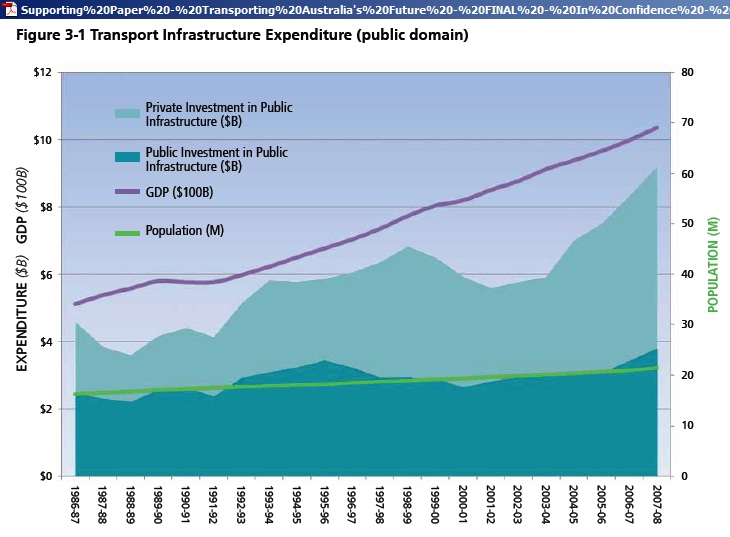
Investments have also shifted more towards expensive public private partnerships:
In an article “Paying for Australia’s Infrastructure Deficit” Nicholas Gruen – who was chair of the Government 2.0 Taskforce – writes:
“Public-private partnerships have turned out to be an expensive way of plugging infrastructure gaps. The evidence shows that governments need to get back into the investment business….
Had the NSW government chosen to fund the toll roads that now encircle Sydney, the state would have acquired ownership of a stream of revenue with a net present value of around $12.8 billion (in 2009–10 dollars), at the cost of increasing its borrowing by $7 billion, according to indicative modelling in a recent study my colleagues and I at Lateral Economics carried out for the councils of Western Sydney”
http://inside.org.au/paying-for-australias-infrastructure-deficit/
The report Nicholas is referring to in his article is here:
Getting Western Sydney Going
http://www.lateraleconomics.com.au/outputs/Getting%20Western%20Sydney%20Going.pdf
The previous posts on toll-ways on this web site have certainly shown how debt-laden privately funded toll-ways are. But to think governments will do the right investments to mitigate the impact of peak oil and global warming is an untested assumption.
Evidence shows otherwise:
1/3/2010 Hunter Expressway: yet another peak oil ignorant project
http://www.crudeoilpeak.com/?p=1203
Work to begin on the Hunter Expressway
29/10/2010
The contract has been signed and work on the second stage of the long-awaited Hunter Expressway will begin early next year.
http://www.theherald.com.au/news/local/news/general/work-to-begin-on-hunter-expressway/1983170.aspx
19/10/2010 NSW government acknowledges peak oil but continues business as usual regardless
http://www.crudeoilpeak.com/?p=1948
28/3/2010 Report Card 2009 (part 3) Nation Building Program spends only 23% on rail, long list of motorways
http://www.crudeoilpeak.com/?p=1282
It seems no one has realized that only rail can substantially improve the productivity of the economy in using oil.
.