Former Soviet Union (FSU) crude oil exports declined from 6.76 mb/d in 2010 to 6.39 mb/d in 2012 (-370 kb/d), or 5.5%, mainly due to a 13% decrease in Black Sea shipments.

The following maps show FSU oil export pipelines:

From: http://omrpublic.iea.org/omrarchive/18jan12full.pdf
..
The Druzba pipeline was put in operation in 1964, connecting oil fields in West Siberia, the Urals and the Caspian Sea with refineries in Poland, Czechoslowakia, East Germany and Hungary. More details: http://en.wikipedia.org/wiki/Druzhba_pipeline

http://omrpublic.iea.org/omrarchive/10jun10full.pdf
Crude exports to the Far East were 650 kb/d in 2012, limited by pipeline capacity. The spur to Daqing can carry up to 300 kb/d
There is a huge variation in monthly crude exports but the trend is clear:

So which countries import e.g. Russian oil?

http://www.eia.gov/countries/cab.cfm?fips=RS
Let’s look at the largest importer, Germany:

http://www.iea.org/publications/freepublications/publication/GermanyOSS.pdf
We see that total crude imports peaked in 2005, declining since then at -3.2% pa. Imports from Russia in 2011 were 7% lower over 6 years (-1% pa), but rather flat since 2009. So it appears that there is a general trend in declining imports caused by high oil prices rather than a direct impact of Russian export decline.
Historic flashback about the peaking of West-Siberian oil fields in the 1980s:
4/10/2010
Russia’s oil peak and the German reunification
http://crudeoilpeak.info/russia%E2%80%99s-oil-peak-and-the-german-reunification
The following graph shows FSU crude oil exports and also oil product exports in relation to total oil supplies. The export peak comes ahead of the production peak:

Total product exports increased by 100 kb/d since 2010, as fuel oil exports are increasing.

This is the result of Russian tax laws favouring product exports which are taxed less than crude oil:

http://omrpublic.iea.org/omrarchive/13mar2013fullpub.pdf
Note that total crude and product exports have peaked while total oil supplies have still been increasing. This is because an oil boom generates more domestic demand for oil resulting in less exports


Oil demand between 2011 and 2012 grew by 3.5% while GDP went up 3.75% , giving a GDP elasticity of oil demand of 1.07, a bit lower than – but within a reasonable range of – the regression equation calculated in Gail the Actuary’s article here:
http://ourfiniteworld.com/2012/07/18/how-much-oil-growth-do-we-need-to-support-world-gdp-growth/
GDP growth rates in the FSU have been higher before the GFC between 5% and 9%.
 Data from: http://www.ers.usda.gov/data-products/international-macroeconomic-data-set.aspx#.UbElw0BTAj4
But Russia’s oil production growth seems to come to an end due to decline in existing fields and a lack of new fields coming on stream:
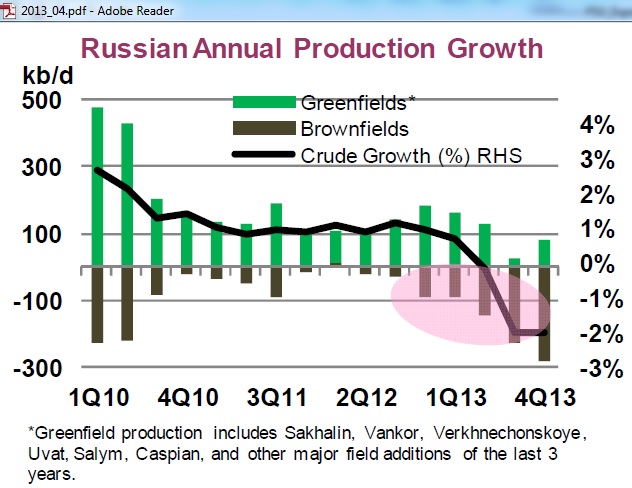
http://omrpublic.iea.org/omrarchive/11apr2013fullpub.pdf
Here is an example of the decline in a legacy field like Samotlor, it’s -4% pa

http://www.tnk-bp.ru/upload/iblock/d8f/TNK-BP_AR_eng_120531_for%20the%20site.pdf
Azerbaijan’s oil production also seems to have peaked,

http://omrpublic.iea.org/omrarchive/12dec12full.pdf
especially in the ACG field (75% of Azerbaijan’s output)

On Kazakhstan, the IEA writes in its March 2013 report:
“In Kazakhstan news reports indicate that despite operator and government hopes that Kashagan’s output could begin as early as April, the field is not expected to begin commercial production until June, in line with our expectations. Kazakhstan’s oil output is forecast to grow by only 30 kb/d in 2013 to 1.65 mb/d despite the startup of the 350 kb/d Kashagan field due to planned maintenance at the Tengiz field this summer and due to mature field decline.”

Background: Astana. An oil boom comes along with a construction boom
Conclusion:
Russia is at its 2nd and last oil peak. The easy oil is gone. The FSU export peak comes ahead of the production peak. Some oil importers can manage a 2-3% decline rate for some time. But watch out for those export decline rates when the many small green fields can no longer offset decline rates of legacy brown fields running at -4% pa and local demand still growing.
Other links:
More graphs with production profiles by field/oil province are here: http://crudeoilpeak.info/russia-peak