Skip to content

Crude Oil Peak

Menu
  • Home
    • About
    • Disclaimer
  • OECD imports
    • France
    • Germany
    • Italy
    • Japan oil imports
    • OECD Europe
    • OECD Pacific
    • South Korea
    • UK
    • US Imports
  • Australian graphs
    • Australian electricity supply graphs
    • Australian crude oil production
    • Australian crude oil reserves
    • Oil import dependency
    • Oil and fuel imports
    • ULP prices
    • Industry stocks
    • End use of oil
    • WA crude oil
    • WA domestic gas
    • East coast conventional gas
    • Geoscience Australia March 2010
    • Geoscience Australia 2005/2006
    • Gippsland
    • LPG
    • Petrol rationing in WW2
  • Oil reserves
    • OPEC paper barrels
    • Kuwait Reserves
    • Strategic Oil Reserve
  • Global Peak
    • Algeria peak
    • Angola peak oil
    • Argentina peak
    • Azerbaijan peak
    • Brazil
    • Brunei peak
    • Canada and tar sands
    • Caspian peak
    • China Peak Oil
    • Deepwater peak
    • Egypt
    • Gabon peak
    • India peak oil
    • Indonesia peak
    • Iran Peak
    • Libya peak oil
    • Malaysia-peak
    • Mexico peak
    • Norway peak oil
    • Qatar peak
    • Russia peak
    • Saudi Arabia export peak
    • Sudan Peak
    • Syria
    • Tunesia
    • UAE peak
    • UK Peak
    • US Peak
    • Vietnam peak
    • Venezuela peak
    • Yemen
  • Energy Transitions
    • Germany energy transition
    • Japan Energy Transition
    • UK Energy Transition
    • US
  • Fuel Shortages
    • China Fuel Shortages
    • Egypt Diesel shortages
    • India petrol price hike
    • Malawi fuel shortage
    • Nepal
    • Nigeria fuel shortage
    • Pakistan petrol shortage
    • Russia
    • Tanzania fuel shortage
    • Uganda Fuel Shortage
    • Yemen fuel shortages
  • I told you so
    • Top Ryde Shopping Centre
    • North South Bypass Tunnel (Clem7) Brisbane
    • Airportlink Brisbane
    • Cross City Tunnel
    • Lane Cove Tunnel
    • Too late for Metro tunnels
    • Australian car manufacturing closing down
    • How the first phase of peak oil brought Virgin Australia into minus after 2008
  • Solutions
    • Night trains
    • Electric Rail on Freeways
    • LNG locomotive conversion
    • Electric trolley buses
    • Walk to school
  • Oil crises
    • Oil crisis 1973
    • My experience oil crisis 1979
    • Historical Oil Disruptions
  • Food and Oil
    • Farm Costs Australia
    • Food crises and political instability
  • Global warming
    • Storms of my Grandchildren
    • Extreme weather events
    • Global warming and petrol lines
    • Compensation claims from global warming damage
    • Sea level rises
    • Why coal seam gas will not reduce CO2 emissions
Menu

10 mouse clicks to calculate Australian crude oil depletion of 83 per cent

Posted on June 25, 2012

Do it yourself. This takes 2 minutes. Australian government web site.

CLICK 1

Type in google the search word “Geoscience Australia”

CLICK 2

Click on http://www.ga.gov.au/

CLICK 3

Click on “Publications”

CLICK 4

Click in the line “Energy” on the link “Oil and Gas Resources of Australia”

 CLICK 5

Click on the 2010 report

CLICK  6

Click on “Reserves”

CLICK 7

Click on “Table 1”

 CLICK  8

http://www.ga.gov.au/products-services/publications/oil-gas-resources-australia/2010/reserves/table-1.html

scroll down to get the crude oil reserves Cat 1+2 = 200.98 GL (Giga Litre)

Go back to the page “Oil and Gas Resources of Australia 2010”

CLICK 9

and click on “Production and Development”

CLICK  10

click on table 2

http://www.ga.gov.au/products-services/publications/oil-gas-resources-australia/2010/production/table-2.html 

In table 2.1, in the total column and in the row “total by year” you get 985.298 GL as cumulative production over all years since oil production started

Calculate end 2010 depletion level

cumulative production / (cumulative production + reserves) =

985 / (985 + 201) =  83%

 DONE

 Bonus:

 CLICK 11

Go back to the Reserve page (click 7) and select table 3 which allows us to have a look at the reserve history of crude oil.
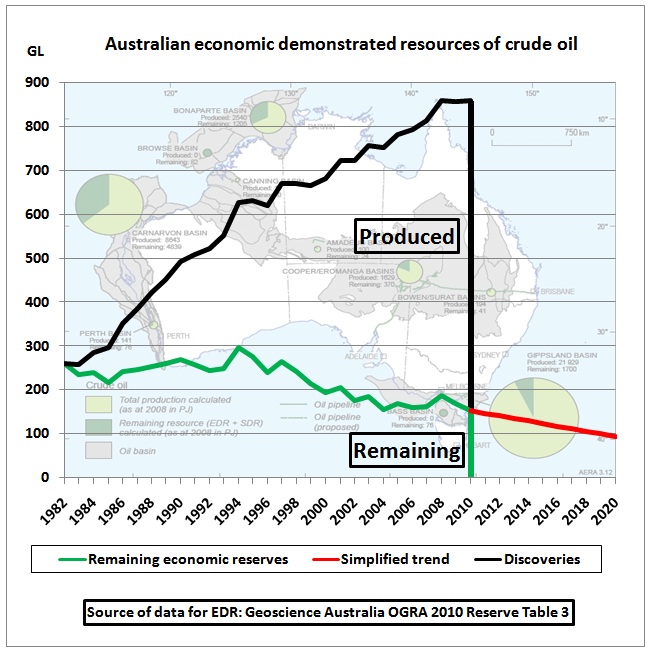
http://www.ga.gov.au/products-services/publications/oil-gas-resources-australia/2010/reserves/table-3.html

The trend since 1994 is well established: a jagged downward slope. For every barrel produced only 0.6 barrels were replaced either by new discoveries (green fields) or  by upward revisions of  past discoveries (brown fields). If both reserve development and production continue as in the last 15 years the red line shows where we are going – barring of course some miracle discoveries. And any additional oil would not come cheap.

We can see that in the last 7 years investment costs per production capacity increased substantially. Data are from here:

www.ga.gov.au/servlet/BigObjFileManager?bigobjid=GA16759

http://www.futuretax.gov.au/content/Publications/downloads/Minerals_and_Petroleum_Exploration_Report.pdf

A document on the tax reform website also found a tripling of exploration costs over 4 years after 2005.

ABS 8412.0 even shows that offshore exploration expenditure has peaked in 2009, possibly as a result of the financial crisis

Conclusion:

Crude oil reserves are dwindling and the remaining oil will be more expensive to produce. Exploration and production will also depend on how the financial crisis evolves.

Key data & graphs

  • Net oil importers
  • Oil Exports
  • Crude oil imports
  • Downloads
  • Latest Graphs
  • Oil price analysis
  • US drilling rig count
  • International drilling rig count
  • Australian fuel prices
  • Diary
  • International oil companies
  • US tight oil production
  • China peak oil
  • World liquids supply – demand balance
  • Tankers arriving and departing in Sydney
  • Australian oil and fuel imports

Latest posts

  • Asia Pacific peak oil update 2025, consumption 5x higher than production
  • Australian jet fuel stock floating offshore while fuel prices are flying away
  • Australian Diesel imports in August dropped from high in May
  • First early hot summer day in spring 2026 and power prices spike at a whopping AUD 23k per MWh
  • Energy Minister Bowen firm in refusing Russian fuel imports but keeps options open for diesel imports from Russian dependent India
  • Australian Energy Minister Bowen downplays diesel supply risk after Saudi Arabia visit

Archives

©2026 Crude Oil Peak | Design: Newspaperly WordPress Theme