We continue to look at what impact US tight oil has on global oil markets, in this post the reduction of US petroleum product imports. This analysis shows that only around one quarter of a drop of 1.7 mb/d since 2005/06 can be explained by the tight oil boom.
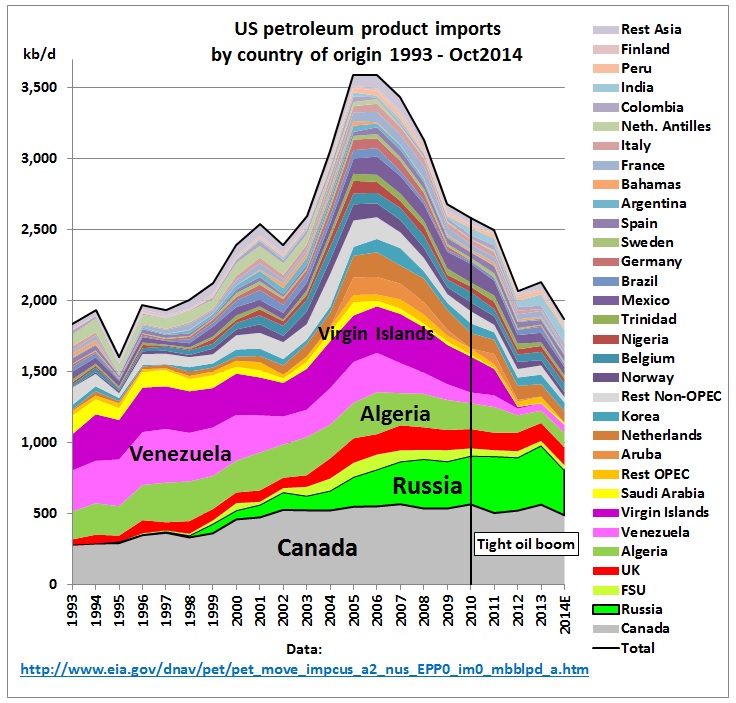
Fig 1: US product imports
The graph shows that US product imports peaked already in 2005/06, long before the tight oil boom started. The drop between that peak and 2010 was around 1 mb/d. Remember that the US went into recession end 2007. A further drop of 700 kb/d happened during the tight oil boom.
(1) US product imports from Venezuela
The biggest drop came from Venezuela and Virgin Islands.
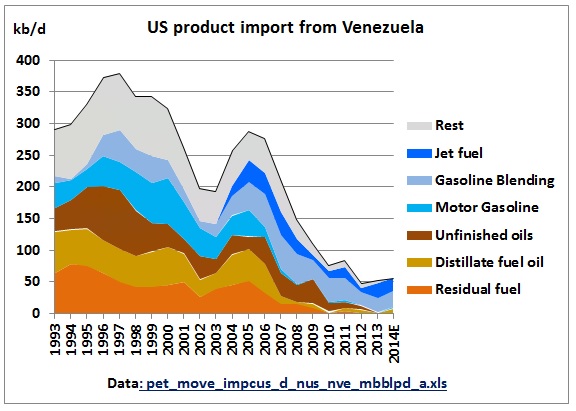
Fig 2: US product imports from Venezuela
Product imports from Venezuela are in long-term decline since 1997. In 1999 el Comandante Chavez came to power, re-instating quotas and trying to exert more power over PDVSA. A new hydrocarbon law was enacted in 2001. These changes were resisted, a coup d’etat attempt followed and an oil strike in 2002/03. That explains the dip in the graph.
On Virgin Islands, the Hovensa refinery in St. Croix was built in 1966 and designed to take heavy Venezuela oil. It had a capacity of 650 kb/d in 1974, last reduced to 350 kb/d in February 2012 when it was closed after US$ 1.3 billion losses were incurred over 3 years. http://www.eia.gov/countries/country-data.cfm?fips=vq
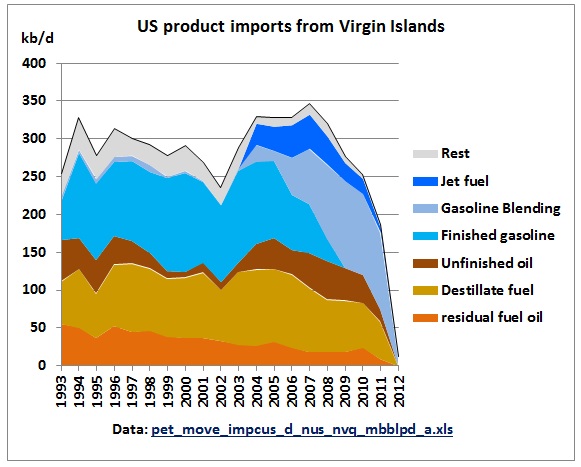
Fig 3: US product imports from Virgin Islands
Let’s see how the product imports compare to the crude imports
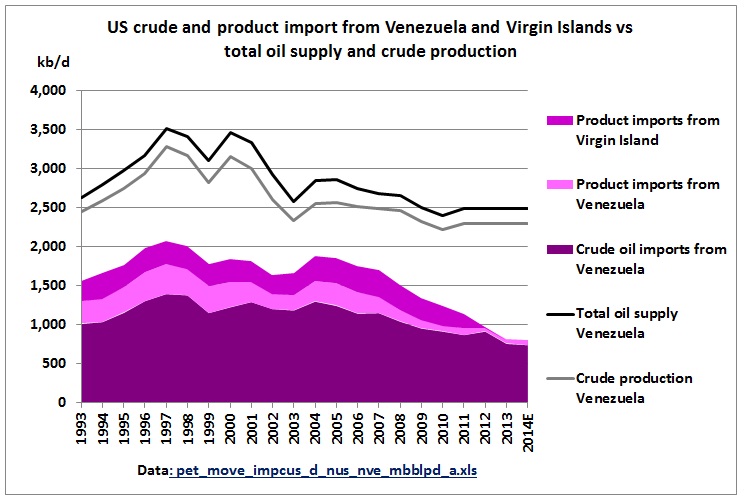
Fig 4: US oil imports from Venezuela
Note that production data haven’t changed for 3 years which does not give us much confidence in these numbers.
In essence, the drop in crude and product imports from Venezuela had more to do with the problems in that country rather than US shale oil (which is a light oil not directly competing with Venezuela’s sour and heavy oil).
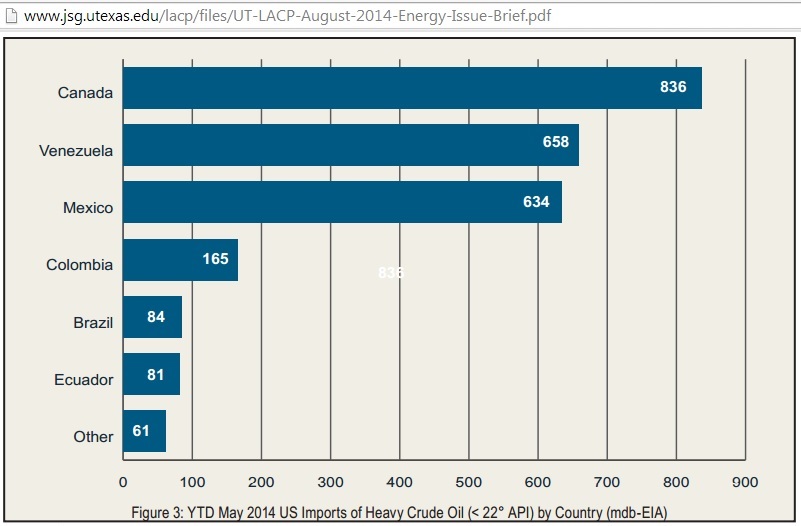
Fig 5: US heavy crude oil imports in May 2014
http://www.jsg.utexas.edu/lacp/files/UT-LACP-August-2014-Energy-Issue-Brief.pdf
So we have to see the drop of US crude imports from Venezuela in the context of increasing US crude imports from Canada, not US tight oil production.
But who benefited from the drop in US imports? The EIA estimates that Venezuela exported 400 kb/d to India and 260 kb/d to China. Venezuelan production may have stabilized somehow due to special financial deals with China providing loans which are paid back by oil in kind.
Chinese President Xi Jinping has signed a series of oil and mineral deals with Venezuela.
22/7/2014
They include a $4bn credit line in return for Venezuelan crude and other products.
http://www.bbc.com/news/world-latin-america-28414623
Why China Just Made A $20B Investment In Venezuela
9/1/2015
Venezuela is suffering from plummeting oil prices, runaway inflation and shortages of basic foodstuffs, but it now has at least one lifeline: a $20 billion investment package from China, announced by Venezuelan President Nicolas Maduro this week. But with Venezuela facing a recession, inflation over 60 percent and widespread predictions of a default on its debt this year, some analysts say it’s hard to pinpoint China’s incentive for handing over the funds.
http://www.ibtimes.com/why-china-just-made-20b-investment-venezuela-1778134
(2) US product imports from Russia
These are mainly unfinished oils from partial refining in Russia which need further processing in the US:
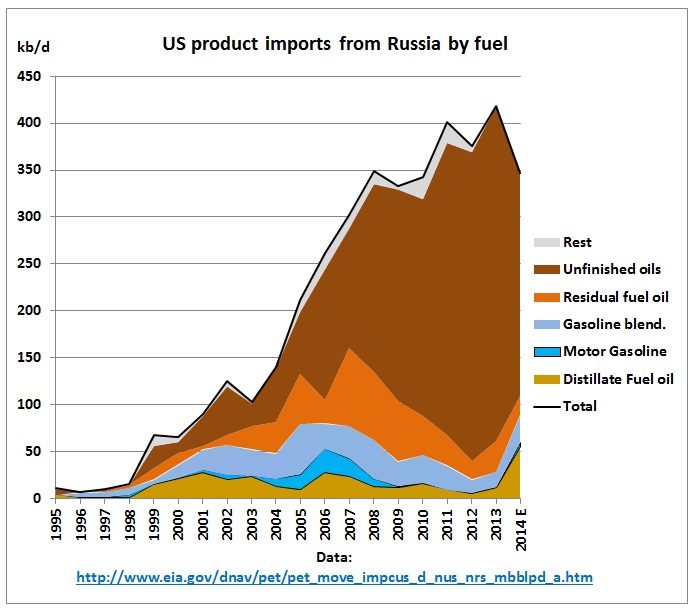
Fig 6: US product imports from Russia
http://www.eia.gov/dnav/pet/pet_move_impcus_d_nus_NRS_mbblpd_a.htm
(3) US product imports from Canada
The level of imports has not changed much since around 2002
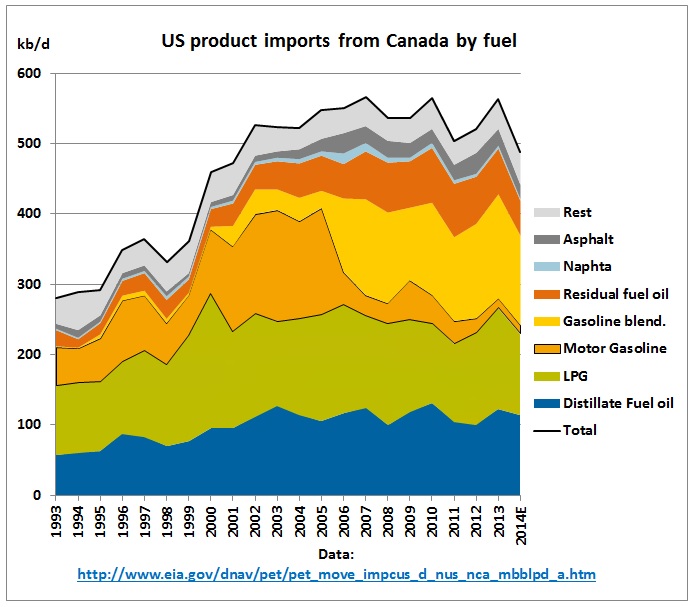
Fig 7: US product imports from Canada
Only gasoline blending components have replaced finished motor gasoline.
(4) US product imports from minor suppliers
Taking the minor suppliers from Fig 1 gives following separate graph:
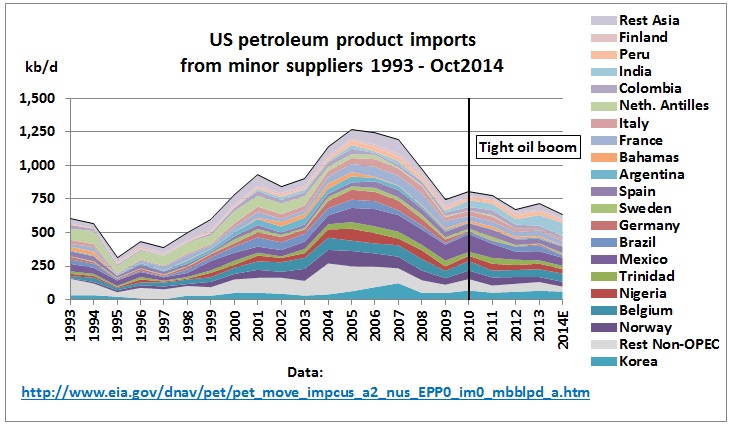
Fig 8: US product imports from minor suppliers
Imports from this group peaked in 2005 and had decreased by around 500 kb/d by 2009, the financial crisis year. The drop during the tight oil boom (2010-2014) was a bit under 200 kb/d, much less.
(5) US product imports from OPEC countries
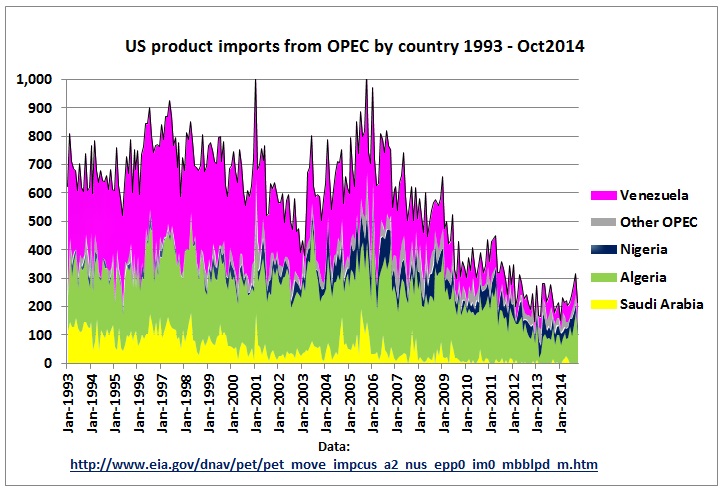
Fig 9: US product imports from OPEC countries
There are 2 peaks here, in 1997 and 2005. Since then US product imports from OPEC have steadily declined from around 800 kb/d to 200 kb/d, out of which only 100 kb/d during the tight oil boom.
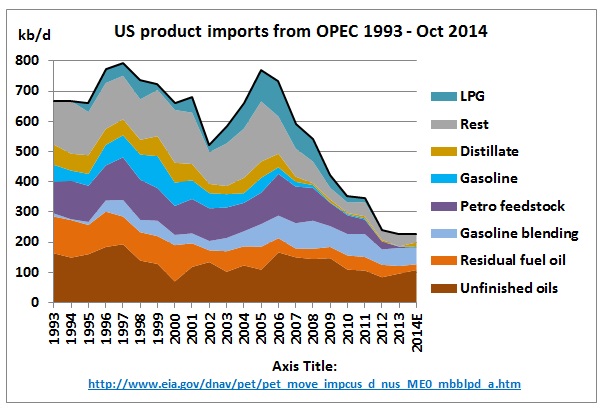
Fig 10: US imports from OPEC by product
Remaining product imports are mainly refinery feedstock.
Summary
US product imports peaked 2005/06 at 3.6 mb/d, 5 years before the tight oil boom started, and dropped to 1.9 mb/d in 2014 (estimate). Out of this drop, only 700 kb/d – or 37% – happened during the tight oil boom. And out of this 700 kb/d around 250 kb/d resulted from the closure of the Virgin Islands refinery in 2012, which used crude from Venezuela, a special case. Therefore, only around 450 kb/d could be attributed to the tight oil boom.
Remaining imports are: Canada 500 kb/d (stable for many years), Russia 350 kb/d, minor suppliers 600 kb/d, rest 250 kb/d. Except for product imports from Russia (mainly unfinished oils) there is not much scope for further big reductions as other imports now come from many different countries, in rather smaller quantities, which are unlikely to move global markets. Many will be spot cargos.
Next post will be on US product exports
Related posts:
3/12/2014
US crude imports from Non-OPEC countries peaked 10 years before tight oil boom
http://crudeoilpeak.info/us-crude-imports-from-non-opec-countries-peaked-10-years-before-tight-oil-boom
6/11/2014
US oil dependency on Middle East has hardly changed since 2007
http://crudeoilpeak.info/us-oil-dependency-on-middle-east-has-hardly-changed-since-2007
5/11/2014
US oil consumption did not increase as result of US tight oil boom
http://crudeoilpeak.info/us-oil-consumption-did-not-increase-as-result-of-us-tight-oil-boom