Skip to content

Crude Oil Peak

Menu
  • Home
    • About
    • Disclaimer
  • OECD imports
    • France
    • Germany
    • Italy
    • Japan oil imports
    • OECD Europe
    • OECD Pacific
    • South Korea
    • UK
    • US Imports
  • Australian graphs
    • Australian electricity supply graphs
    • Australian crude oil production
    • Australian crude oil reserves
    • Oil import dependency
    • Oil and fuel imports
    • ULP prices
    • Industry stocks
    • End use of oil
    • WA crude oil
    • WA domestic gas
    • East coast conventional gas
    • Geoscience Australia March 2010
    • Geoscience Australia 2005/2006
    • Gippsland
    • LPG
    • Petrol rationing in WW2
  • Oil reserves
    • OPEC paper barrels
    • Kuwait Reserves
    • Strategic Oil Reserve
  • Global Peak
    • Algeria peak
    • Angola peak oil
    • Argentina peak
    • Azerbaijan peak
    • Brazil
    • Brunei peak
    • Canada and tar sands
    • Caspian peak
    • China Peak Oil
    • Deepwater peak
    • Egypt
    • Gabon peak
    • India peak oil
    • Indonesia peak
    • Iran Peak
    • Libya peak oil
    • Malaysia-peak
    • Mexico peak
    • Norway peak oil
    • Qatar peak
    • Russia peak
    • Saudi Arabia export peak
    • Sudan Peak
    • Syria
    • Tunesia
    • UAE peak
    • UK Peak
    • US Peak
    • Vietnam peak
    • Venezuela peak
    • Yemen
  • Energy Transitions
    • Germany energy transition
    • Japan Energy Transition
    • UK Energy Transition
    • US
  • Fuel Shortages
    • China Fuel Shortages
    • Egypt Diesel shortages
    • India petrol price hike
    • Malawi fuel shortage
    • Nepal
    • Nigeria fuel shortage
    • Pakistan petrol shortage
    • Russia
    • Tanzania fuel shortage
    • Uganda Fuel Shortage
    • Yemen fuel shortages
  • I told you so
    • Top Ryde Shopping Centre
    • North South Bypass Tunnel (Clem7) Brisbane
    • Airportlink Brisbane
    • Cross City Tunnel
    • Lane Cove Tunnel
    • Too late for Metro tunnels
    • Australian car manufacturing closing down
    • How the first phase of peak oil brought Virgin Australia into minus after 2008
  • Solutions
    • Night trains
    • Electric Rail on Freeways
    • LNG locomotive conversion
    • Electric trolley buses
    • Walk to school
  • Oil crises
    • Oil crisis 1973
    • My experience oil crisis 1979
    • Historical Oil Disruptions
  • Food and Oil
    • Farm Costs Australia
    • Food crises and political instability
  • Global warming
    • Storms of my Grandchildren
    • Extreme weather events
    • Global warming and petrol lines
    • Compensation claims from global warming damage
    • Sea level rises
    • Why coal seam gas will not reduce CO2 emissions
Menu

Asia’s oil consumption at record high while production peaked in 2010

Posted on June 23, 2015

The annual BP Statistical Review has come out, as usual in June. In this post we focus on the Asia Pacific region. This is important because the Australian government has offered the help of “Team Australia” to build the “Asian Century”. The question no one asks (or wants to ask) is how much oil there is to carry Asia through the decades to come. No one can give an answer of course but it is clear that if past oil consumption and production trends continue the region will slide into a huge oil crisis.

Overview

Oil production in the Asia Pacific peaked in 2010 (China offshore!) at 8.4 mb/d while consumption continued to increase to 30.9 mb/d.

Fig 1: Asia-Pacific oil production and consumption

The difference between consumption and production (net imports) is now 73% of consumption, up from 68% ten years ago.

Oil consumption changes

Let’s zoom into the last 10 years. Consumption growth dropped from 6.2% in 2009/10 to 1.5% in 2013/2014 but this is still an annual 440 kb/d. If this reduced consumption growth were to continue an extra 2.2 mb/d would be needed by 2020 and 4.4 mb/d by 2025.

Fig 2:  Asia’s oil production and consumption changes since 2005

Since global crude oil production started to peak in 2005 (base year in above graph), Asia did remarkably well to suck additional oil out of the global market, around 6 mb/d

Fig 3: Asia’s oil consumption changes after 2005

The main drivers are China, India and Japan.

China’s consumption growth was running at an average of +430 kb/d pa over the last 10 years, but with huge variations during the financial crisis and the recovery year of 2010 when it peaked at 1.05 mb/d. In 2014 it was still +380 kb/d. If consumption growth continued at the levels of the last 3 years, China would need an additional 2 mb/d by 2020.

This is important to know because China’s share of consumption growth is 49% while India’s is just 15%. The rest, 36% comes from all other Asian countries.

Consumption decline can mainly be seen in Japan. But in 2012, fuel oil use and direct crude oil burn in power plants had to be increased after the Fukushima accident.

Fig 4: Asia’s incremental oil consumption 2005-2014

The big Asian consumers

In the following graphs, “net imports” means the difference between oil consumption and production.

Fig 5: China consumption vs production

Fig 6: India consumption vs production

Fig 7: Japan’s oil imports

Fig 8: South Korea’s oil imports

Fig 9: Singapore’s oil imports

5 South East Asian oil producers

Fig 10: Indonesia is in peak oil mode

..

Fig 11: Malaysia peaked in 2004 but remained on a bumpy plateau during the last 4 years
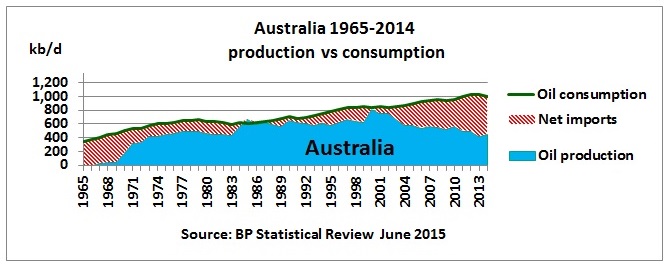
Fig 12: Australia peaked in 2000

Fig 13: Thailand’s oil production stagnated in the last 3 years

Fig 14: Vietnam has become a small net importer

All together now

Fig 15: South East Asia peaked in 2000 while consumption continues to grow

Conclusion:

It should be crystal clear that the much hyped Asian Century will last as long as increasing oil imports can keep the economies going. In a following post we’ll analyse where the imported oil is coming from.

Previous post:

18/6/2013
South East Asian oil producers – the widening gap between oil production and consumption
https://crudeoilpeak.info/south-east-asian-oil-producers-the-widening-gap-between-oil-production-and-consumption

Updates:

10/9/2020
Peak oil in Asia Update June 2020 (part 4)
https://crudeoilpeak.info/peak-oil-in-asia-update-june-2020-part-4

17/8/2020
Peak oil in Asia Update June 2020 (part 3)
https://crudeoilpeak.info/peak-oil-in-asia-update-june-2020-part-3

15/7/2020
Peak oil in Asia Update June 2020 (part 2)
https://crudeoilpeak.info/peak-oil-in-asia-update-june-2020-part-2

30/6/2020
Peak oil in Asia Update June 2020 (part 1)
https://crudeoilpeak.info/peak-oil-in-asia-update-june-2020-part-1

Key data & graphs

  • Net oil importers
  • Oil Exports
  • Crude oil imports
  • Downloads
  • Latest Graphs
  • Oil price analysis
  • US drilling rig count
  • International drilling rig count
  • Australian fuel prices
  • Diary
  • International oil companies
  • US tight oil production
  • China peak oil
  • World liquids supply – demand balance
  • Tankers arriving and departing in Sydney
  • Australian oil and fuel imports

Latest posts

  • Australian Energy Minister – Asked About Reports of Three Tankers Burning in Hormuz – Sees Only “General Uncertainty”
  • Jet fuel stocks just 2.6 days above the Minimum Stockholding Obligation as new Western Sydney Airport enthusiasm soars
  • Asia Pacific peak oil update 2025, consumption 5x higher than production
  • Australian jet fuel stock floating offshore while fuel prices are flying away
  • Australian Diesel imports in August dropped from high in May
  • First early hot summer day in spring 2026 and power prices spike at a whopping AUD 23k per MWh

Archives

©2026 Crude Oil Peak | Design: Newspaperly WordPress Theme