Skip to content

Crude Oil Peak

Menu
  • Home
    • About
    • Disclaimer
  • OECD imports
    • France
    • Germany
    • Italy
    • Japan oil imports
    • OECD Europe
    • OECD Pacific
    • South Korea
    • UK
    • US Imports
  • Australian graphs
    • Australian electricity supply graphs
    • Australian crude oil production
    • Australian crude oil reserves
    • Oil import dependency
    • Oil and fuel imports
    • ULP prices
    • Industry stocks
    • End use of oil
    • WA crude oil
    • WA domestic gas
    • East coast conventional gas
    • Geoscience Australia March 2010
    • Geoscience Australia 2005/2006
    • Gippsland
    • LPG
    • Petrol rationing in WW2
  • Oil reserves
    • OPEC paper barrels
    • Kuwait Reserves
    • Strategic Oil Reserve
  • Global Peak
    • Algeria peak
    • Angola peak oil
    • Argentina peak
    • Azerbaijan peak
    • Brazil
    • Brunei peak
    • Canada and tar sands
    • Caspian peak
    • China Peak Oil
    • Deepwater peak
    • Egypt
    • Gabon peak
    • India peak oil
    • Indonesia peak
    • Iran Peak
    • Libya peak oil
    • Malaysia-peak
    • Mexico peak
    • Norway peak oil
    • Qatar peak
    • Russia peak
    • Saudi Arabia export peak
    • Sudan Peak
    • Syria
    • Tunesia
    • UAE peak
    • UK Peak
    • US Peak
    • Vietnam peak
    • Venezuela peak
    • Yemen
  • Energy Transitions
    • Germany energy transition
    • Japan Energy Transition
    • UK Energy Transition
    • US
  • Fuel Shortages
    • China Fuel Shortages
    • Egypt Diesel shortages
    • India petrol price hike
    • Malawi fuel shortage
    • Nepal
    • Nigeria fuel shortage
    • Pakistan petrol shortage
    • Russia
    • Tanzania fuel shortage
    • Uganda Fuel Shortage
    • Yemen fuel shortages
  • I told you so
    • Top Ryde Shopping Centre
    • North South Bypass Tunnel (Clem7) Brisbane
    • Airportlink Brisbane
    • Cross City Tunnel
    • Lane Cove Tunnel
    • Too late for Metro tunnels
    • Australian car manufacturing closing down
    • How the first phase of peak oil brought Virgin Australia into minus after 2008
  • Solutions
    • Night trains
    • Electric Rail on Freeways
    • LNG locomotive conversion
    • Electric trolley buses
    • Walk to school
  • Oil crises
    • Oil crisis 1973
    • My experience oil crisis 1979
    • Historical Oil Disruptions
  • Food and Oil
    • Farm Costs Australia
    • Food crises and political instability
  • Global warming
    • Storms of my Grandchildren
    • Extreme weather events
    • Global warming and petrol lines
    • Compensation claims from global warming damage
    • Sea level rises
    • Why coal seam gas will not reduce CO2 emissions
Menu

Saudi Update October 2018

Posted on October 30, 2018

We do not know where the Khashoggi case will go but what is happening in Saudi Arabia is  important for the world.

Jodi data up to Aug 2018, released 19/10/2018  http://www.jodidb.org

Major_crude_exporters_Oct2018Fig 1: Saudi Arabia is crude exporter #1

Note that these are gross exports. The US (which is a net importer of crude) is shown for comparison.

SaudiArabia_crude_prod_exports_2002-Aug2018_JodiFig 2: Saudi crude production and exports

Crude oil exports (red line) have been on a bumpy plateau between 7-8 mb/d since 2011, but in 2018 were actually lower than in 2005 when global crude production first peaked. Increases in production (black line) were modest (compared to Saudi’s claimed reserves of 266 Gb) and mainly used domestically:

Saudi_crude_use_exports_2002-Aug2018Fig 3: Use of Saudi crude production (stacked)

The light green area is stock build, the dark red area stock draw (sitting on top of the production curve) and used as refiner intake. See Fig 8 for more details.

Saudi_direct_burn_2009-Aug2018Fig 4: Saudi direct crude burn in power plants

This is highly seasonal between 300 kb/d in winter and 600 kb/d in summer.

Riyadh_PP9Fig 5: Location of Riyadh’s power plant PP9

Riyadh_crude-oil-power-plant-9Fig 6: Riyadh’s crude oil power plant PP9

PP9 is the largest crude oil plant in the world (5,980 MW). In 2016, Saudi Arabia had a total 66 GW installed, generating 330 billion KWh.

In order to free crude oil for use in refineries and chemical complexes, peak crude burn has been reduced (see Fig 4) as more gas is used:

Saudi_power-supply_by_fuel_2007-14Fig 7: Fuels used for power generation

http://npolicy.org/Articles/March%202018%20Drafts/Mills_Saudi_Arabia_Feb18.pdf

Crude inventories

Saudi-Arabia_crude-stock_Aug2018Fig 8: Saudi monthly crude oil stock changes

Saudi closing crude stock peaked in October 2015. Since then, around 100 mb have been drawn, on average 100 kb/d or 4% of refinery intake. For a couple of months, this was around 300 kb/d

Oil products

Saudi-Arabia-products_Jan2002-Aug2018Fig 9: Saudi refinery output

Saudi_product-exports_2002-Aug2018Fig 10: Saudi product exports

Saudi_product-imports_2002-Aug2018Fig 11: Saudi product imports

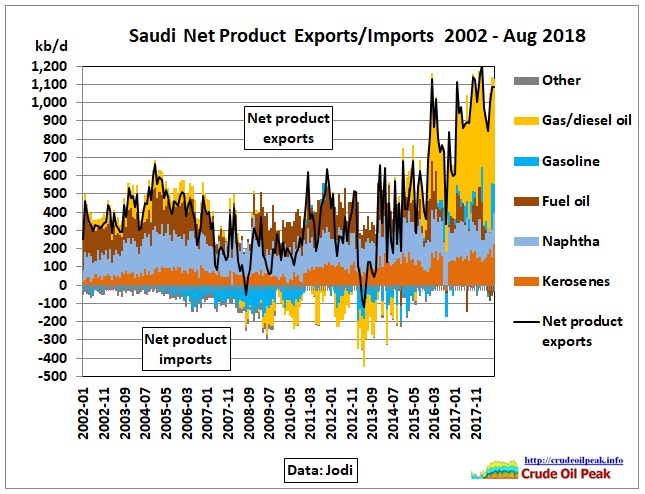
Saudi_net-product-exports_2002-Aug2018Fig 12: Saudi net product exports/imports

In the last years, Saudi Arabia has virtually eliminated net product imports which of course had to be heavily subsidised.

Saudi-net-liquids-exports_2002-Aug2018Fig 13: Saudi net liquids exports

The crude exports decline between 2005 and mid 2007 caused oil prices to go up and the US recession end 2007. In 2017/18 net liquids exports were just 160 kb/d higher than in 2005 while crude exports had actually fallen by around 400 kb/d.

Natural Gas liquids

Saudi-crude-NGL-production_EIA_1980-2017Fig 14: Saudi total liquids production

BP Statistical Review data

Saudi_oil-production-consumption_1965-2017Fig 15: Saudi oil production vs consumption

Note that oil in the above graph includes NGLs (Fig 14)

Saudi_crude_exports_2017_BPStatFig 16: Saudi oil exports by destination

Conclusion

Saudi Arabia’s net liquids exports are not growing commensurate with oil demand in Asia, the destination of 70% of Saudi oil. If something were to happen in this country impacting on oil production and/or oil exports, this would worsen the situation and hit Asia’s and therefore the world’s economy.

Related posts:

5/7/2018  Saudi Arabia was supposed to pump almost 14 mb/d in 2018
http://crudeoilpeak.info/saudi-arabia-was-supposed-to-pump-almost-14-mbd-in-2018

2/3/2011   WikiLeaks cable from Riyadh implied Saudis could pump only 9.8 mb/d in 2011
http://crudeoilpeak.info/wikileaks-cable-from-riyadh-implied-saudis-could-pump-only-9-8-mbd-in-2011

Key data & graphs

  • Net oil importers
  • Oil Exports
  • Crude oil imports
  • Downloads
  • Latest Graphs
  • Oil price analysis
  • US drilling rig count
  • International drilling rig count
  • Australian fuel prices
  • Diary
  • International oil companies
  • US tight oil production
  • China peak oil
  • World liquids supply – demand balance
  • Tankers arriving and departing in Sydney
  • Australian oil and fuel imports

Latest posts

  • Asia Pacific peak oil update 2025, consumption 5x higher than production
  • Australian jet fuel stock floating offshore while fuel prices are flying away
  • Australian Diesel imports in August dropped from high in May
  • First early hot summer day in spring 2026 and power prices spike at a whopping AUD 23k per MWh
  • Energy Minister Bowen firm in refusing Russian fuel imports but keeps options open for diesel imports from Russian dependent India
  • Australian Energy Minister Bowen downplays diesel supply risk after Saudi Arabia visit

Archives

©2026 Crude Oil Peak | Design: Newspaperly WordPress Theme