Unnoticed by the mainstream media, US shale oil covers up a recent decline of crude oil production of 1.5 mb/d in the rest of world (using data up to Oct 2013). This means that without US shale oil the world would be in a deep oil crisis similar to the decline phase 2006/07 when oil prices went up. The decline comes from many countries but is also caused by fights over oil and oil-related issues in Iran, Libya and other countries which can be seen on TV every day.

Fig 1: World’s incremental crude oil production Oct 2013
Incremental production for each country is calculated as the difference between total production and the minimum production between Jan 2001 and Oct 2013. The sum of minima is the base production. Countries which had substantial changes in production appear as large areas in the graph. Russia supplied – quite reliably – the largest increment and the North Sea (UK and Norway) had the largest losses. Countries which feature prominently are Venezuela (low production in Jan 2003 due to a strike), Iraq (low production in April 2003 during the Iraq war), Libya (war in 2011), Iran (sanctions) and Saudi Arabia (production increase since 2002 and swing role)
Production is stacked from bottom as follows:
(1) countries with growing production: Kazachstan (recently flat), Russia (only +100 kb/d last year), Colombia (+60 kb/d), China (recently flat) and Canada (+200 kb/d syncrude from tarsands)
(2) Countries flat or in decline like UK and Norway
(3) countries which recently peaked: Brazil and Azerbaijan
Groups (1) to (3) peaked in Nov 2011 (dashed line) and declined by 1.2 mb/ since then
(4) OPEC countries with Iraq, Saudi Arabia, Iran and Libya
(5) US on top to see the impact of shale oil
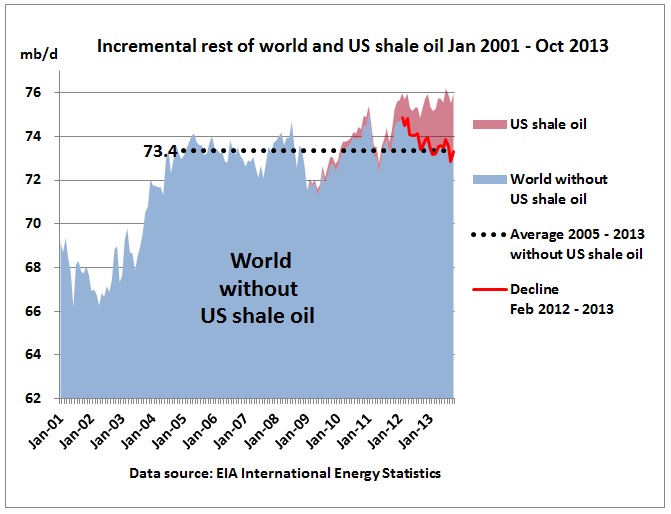
Fig 2: US shale covers up recent decline in rest of world
The world without shale oil declined after a recent peak in Feb 2012.to an average of 73.4 mb/d in 2013, incidentally the same average seen for the whole period since 2005 when crude production was 73.6 mb/d
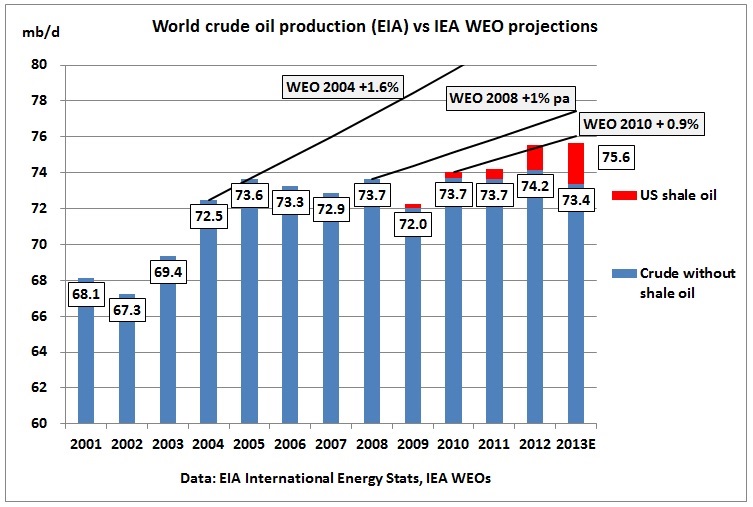
Fig 3: Annual crude oil production and US shale oil vs IAE’s WEO projections
The rest of world continues on a bumpy crude oil production plateau. Oil demand and supply projections of the International Energy Agency in 2004 and 2008 did not materialize. Only the 2010 WEO came close but only due to US shale oil which had not been predicted at the time to the extend it actually increased.
Let’s have a look at the main players in the upper part of Fig 1

Fig 4: Incremental crude production of Iraq, Iran, Libya, Saudi Arabia and US
We can see that Saudi Arabia declined in 2006/07 (prices up), pumped more in the Oilympic peak year of 2008, (but not enough and prices skyrocketed), served as a (negative) swing producer during the financial crisis year of 2009 and stepped in (belatedly) when the war in Libya started and continued pumping at record levels when sanctions on Iran started. US shale oil has not brought down oil prices substantially and definitely the US does not act as swing producer. Most shale oil producers would go into receivership if they stopped pumping. Saudi Arabia apparently tries to compensate for Libyan and Iranian production losses but does not seem to reduce crude production to offset US shale oil. Iraq will have to return to OPEC’s quota system. It will be interesting to watch at which production level that will be agreed upon and whether Iraq will adhere to it. In any case, all ME oil producers need to balance their budgets as highlighted in this post:
14/8/2013 OPEC’s average fiscal break-even oil price increases by 7% in 2013
https://crudeoilpeak.info/opec-fiscal-breakeven-oil-price-increases-7-in-2013
.

Fig 5: Middle East only.
Decline in Syria and Yemen was offset by increases in Kuwait, UEA and Qatar. Iraq could not offset Iran’s production drops.
Russia and FSU

Fig 6: Eurasia
Former FSU countries: Azerbaijan declines at 50 kb/d after its peak in 2010. Kazakhstan is flat since 2010.

Fig 7: Russian crude oil production growth is slowing
Russia, producing now at 10 mb/d, is still growing at around 100 kb/d but this growth rate is down from 2010 and 2012 years.
The IEA WEO 2013 writes: “Oil production in Russia is approaching the record levels of the Soviet era, but maintaining this trend will be difficult, given the need to combat declines at the giant western Siberian fields that currently produce the bulk of the country’s oil.”
http://www.worldenergyoutlook.org/publications/weo-2013/
Europe

Fig 8: The North Sea is in full decline
Africa

Fig 9: Incremental production in Africa
Irrespective of what is happening in Libya, Africa peaked.
Latin America

Fig 10: Latin America
Brazil seems to have peaked while Colombia slowly increased heavy oil production. Venezuela’s data appear sus as they have not been updated since Jan 2011
Summary
Since end 2010, the group of still growing countries (+1.2 mb/d) can’t offset decline elsewhere (-2.4 mb/d), giving a resulting decline of 1.2 mb/d or 400 kb/d p.a. This is mainly oil-geologically determined decline.
OPEC, which is usually called upon to provide for the difference between demand and non-OPEC production, has got its own problems (geopolitical feed-back loops caused by peaking oil production) and was not able to fill that gap. Global crude oil without US shale oil declined by 1.5 mb/d since its most recent peak in Feb 2012.
Conclusion:
While the mainstream media lulls the public into believing that US shale oil is a revolution, peaking oil production in many countries eats like a cancer through the oil supply system. The big problem is that more oil dependent infrastructure is being built which will not be needed when US shale oil peaks and the underlying decline is revealed.